
automation in port terminal operations
Automation in a port terminal context means replacing repetitive, high-risk, and schedule-driven tasks with automated systems that coordinate equipment and people. In practice this includes AUTOMATED GUIDED VEHICLES and automated stacking cranes, AI-driven Terminal Operating Systems, and robotic QUAY CRANES working together to move, stack, and track containers. When terminals adopt automation they change workflows from manually operated sequences to predictable, measured flows. The contrast matters. Conventional container workflows rely on human judgement, radios, and fixed rules. Automated systems coordinate moves with fewer interruptions, and they raise throughput by about 20–30% while cutting labour requirements by up to 50% according to industry design studies A design approach for robotized maritime container terminals. This statistic shows how automation shifts where value is created in a port.
Safety and sustainability improve as well. Automated cranes and AGVs reduce the number of close-quarters interactions, which decreases incident rates and reduces downtime. Energy use falls when automated processes smooth peaks and reduce idle times. For example, ports that install automated systems can lower the industry’s carbon footprint through optimized truck dwell, reduced tug and truck idling, and better yard planning. The result is fewer emissions and a safer work environment for dockworkers and port workers.
Because the shift requires planning and investment, terminal operators must measure expected gains versus the initial investment and transition costs. Planners should evaluate automation against local conditions, regulatory constraints, and staffing objectives. Loadmaster.ai helps terminals prepare by simulating operational scenarios in a digital twin and recommending how to augment human skills while you automate moves. For an in-depth view of how digital twins integrate with existing systems see our guide on digital twin integration with terminal operating systems. The next step is to select the right mix of automated equipment to match vessel schedules, yard size, and cargo types.
container terminal automation and terminal automation technologies
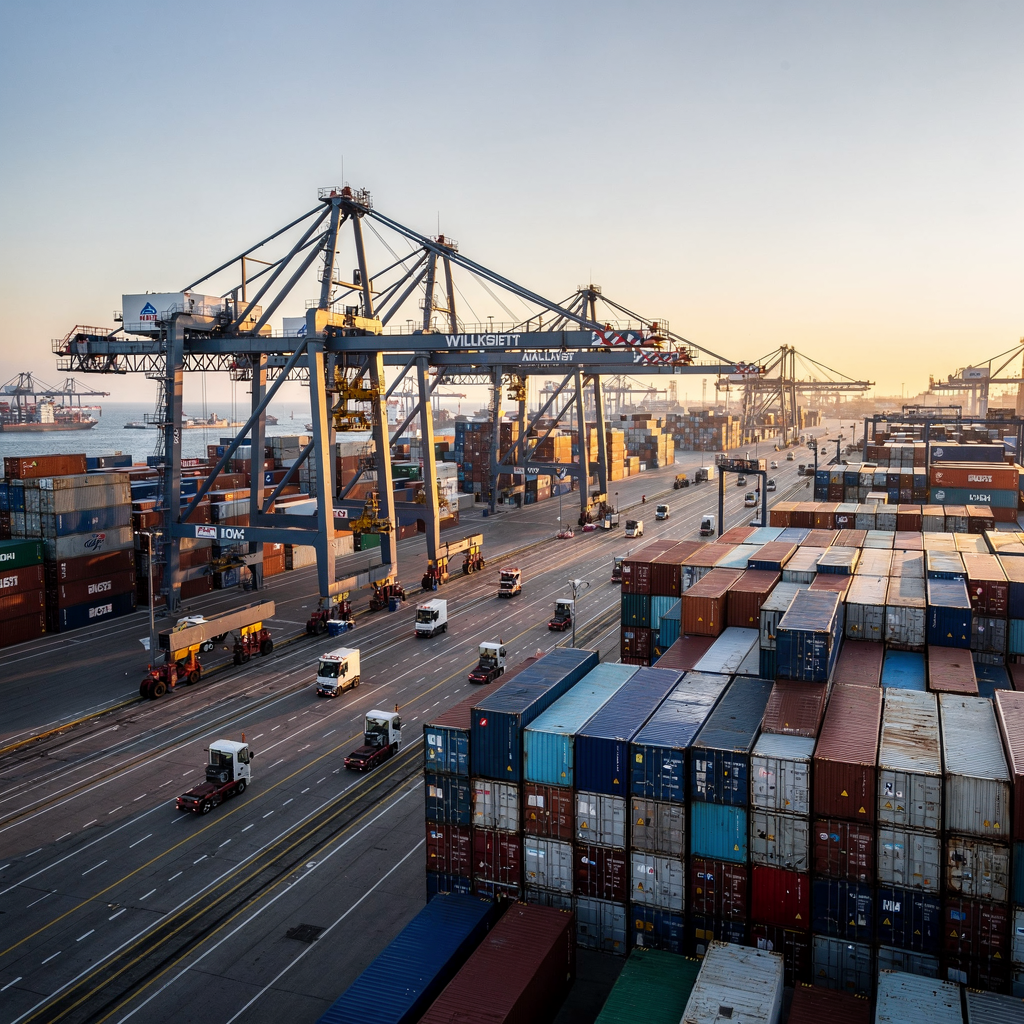
Container terminal automation depends on a set of complementary technologies. Key systems include automated guided vehicles (AGVs), agv units, automated stacking cranes (ASCs), automated QUAY CRANES, and gantry cranes fitted with remote control and sensing. Stacking cranes and ASCs handle high-density stacking and reshuffles, while AGVs move containers between the quay and the CONTAINER YARD. Straddle carriers still operate in many terminals and can be part of a partially automated configuration when combined with automated equipment and coordination software.
Integrating terminal automation with legacy port equipment presents both technical and organisational challenges. Ports often have a mix of MANUALLY OPERATED cranes and retrofitted automated components. Integrators must connect new automated systems to existing TOS platforms and to terminal gates. For guidance on configuring TOS for automation, see our piece on optimizing TOS configuration for performance. In practice integration requires rigorous testing in a sandboxed environment and staged rollouts so that terminal operators keep containers moving during transition.
AI and machine learning play a central role in predictive maintenance and operational decision-making. Predictive models detect failing sensors, worn winches, and misaligned spreaders before they cause a breakdown. This reduces unplanned downtime and extends equipment life. Predictive maintenance also lowers operating costs and keeps crane availability high, which directly supports productivity targets. Loadmaster.ai uses reinforcement learning agents to train policies in a digital twin so terminals achieve better allocation of cranes and trucks under real-world uncertainty. That approach contrasts with traditional supervised models which mirror past behaviour rather than search for improved policies. For more on AI-native architectures see our article on AI-native container terminals with multi-agent planning architectures.
Drowning in a full terminal with replans, exceptions and last-minute changes?
Discover what AI-driven planning can do for your terminal
automated container terminal: increase efficiency
A fully automated container terminal can raise operational efficiency across quay, yard, and gate. Studies find cost reductions between 25% and 40% and vessel turnaround time improvements up to 30% mckinsey. These figures show why many ports around the world plan automation initiatives. A fully automated container terminal or a new automated block within a yard reduces rehandles and concentrates crane work, which increases moves per hour and reduces operating expenses.
Case studies of fully automated pilots highlight measurable gains. For example, some terminals reporting automation pilots saw a 20–30% rise in productivity and a halving of routine labour hours when they moved to automated processes. The first fully automated container terminal pilots—at sites such as the SHANGHAI YANGSHAN DEEP WATER PORT and other large ports—demonstrate how automation scales with volume. Shanghai Yangshan’s operation is often cited among the world’s largest examples of new automated systems at scale. The Victoria International Container Terminal and the Port of Rotterdam have also trialed high levels of automation and data-driven control in specific blocks.
Data analytics and real-time monitoring fuels continuous improvement. Terminals feed telemetry from quay cranes, truck movements, and terminal gates into dashboards. Analysts and AI agents then adjust sequences, priorities, and equipment assignment to reduce delays and avoid congestion. Loadmaster.ai’s three-agent architecture—StowAI, StackAI, and JobAI—applies reinforcement learning to coordinate quay cranes and yard moves, which cuts unnecessary travel and rehandles. That closed-loop optimisation turns raw telemetry into ongoing performance gains. To explore planning architectures that support this approach see our analysis of next-generation container terminal planning architecture. The net effect is fewer interruptions, faster vessel service, and lower costs of automated operations.
port automation with automated port terminals
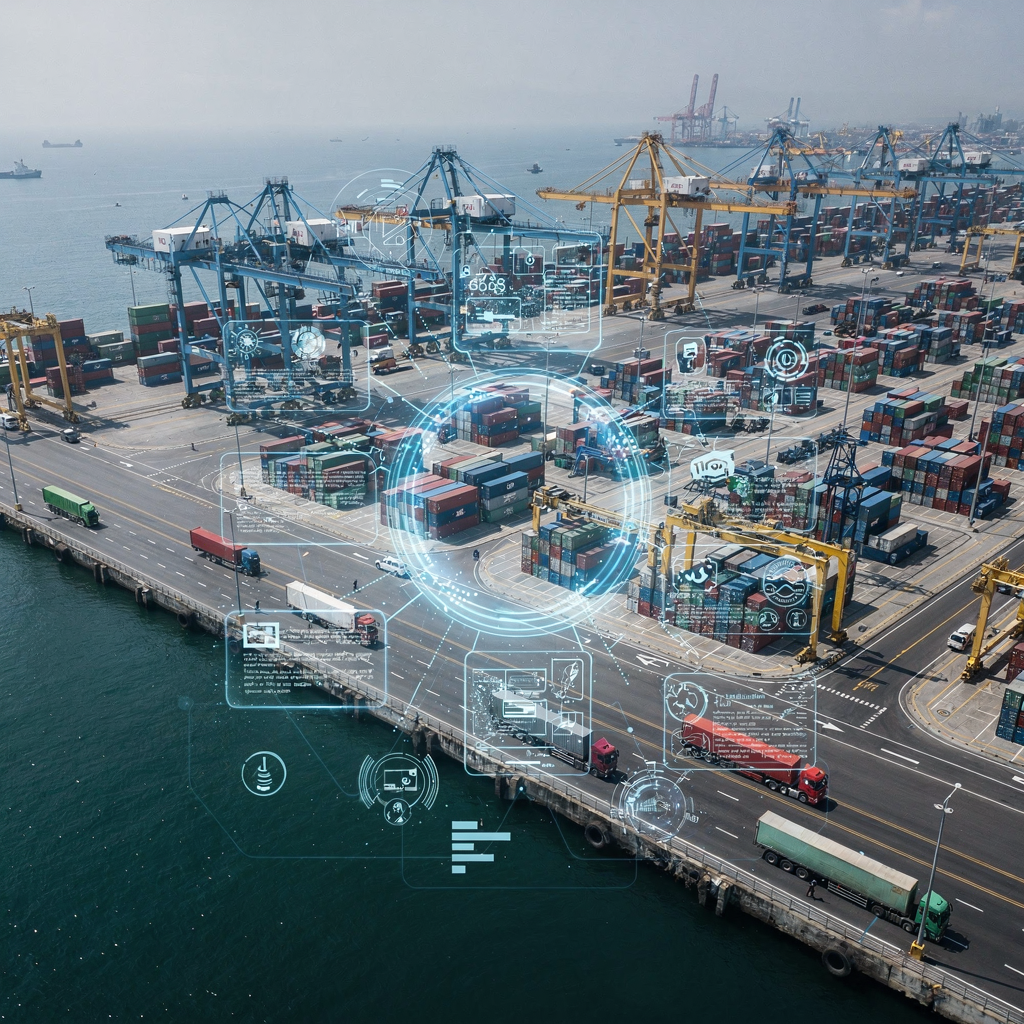
Smart port infrastructure builds on sensors, connectivity, and modelling. Internet of Things devices on cranes, trucks, and gates stream status and workload. Digital twin platforms then mirror the physical port, allowing planners to test schedules and to simulate disruption recovery. Research shows that digital twins help assess resilience and sustainability across port facilities Digital Twin for resilience and sustainability assessment of port facility. These tools let terminal operators prepare for peak traffic and for unusual vessel mixes.
Market forecasts expect the port infrastructure market to expand strongly to 2032 driven by investments in digital twins and automation Port Infrastructure Market Size, Share & Trends | Report [2032]. As ports add automated equipment they can reduce dwell time for trucks and vans, lower demurrage and detention costs, and optimise yard utilisation. A key metric for planners is the container port performance index which captures moves per hour, average truck turnaround, and yard density. Improvements here translate directly into lower operating expenses and better service for shipping companies.
Economic benefits extend to avoiding port congestion. Automated port terminals can smooth peaks by sequencing arrivals and by prioritising stacks that free gate throughput. That reduces queueing, and it reduces fuel burn among waiting trucks. While high initial investment is a real barrier, the long-term savings on labour costs, energy, and turnaround make the case compelling for many major hubs. For a look at capacity planning and how digital twins support it see our guide on capacity planning using digital twins. Across ports along key trade lanes, automation technology also supports resilience and predictable schedules for container vessels and for inland connectors.
Drowning in a full terminal with replans, exceptions and last-minute changes?
Discover what AI-driven planning can do for your terminal
port and maritime insights
Automated terminals influence global supply chains by reducing uncertainty and by improving predictability. For shipping companies a reliable port window means fewer delays and better schedule integrity. Terminals that increase efficiency and productivity also reduce congestion in feeder networks, which benefits inland intermodal hubs. The strategic importance of an automated port goes beyond local gains; it supports resilience during demand fluctuations and during episodic disruptions.
Industry experts stress that automation is not just a labour substitution. As one operations manager put it, “Automation is not just about replacing labor; it’s about creating a smarter, more resilient port that can adapt to fluctuating demand and unexpected disruptions” Enhancing Efficiency at Ports and Terminals for Ocean Freight. That view ties into the use of digital twins to run scenarios and to prepare contingency plans. The tools also help terminal operators balance trade-offs between quay productivity and yard congestion.
Environmental and regulatory considerations shape adoption. Regulations that target emissions and noise push terminals toward electric vehicles and automated cargo handling that reduce idling. The industry must also manage workforce impacts and address concerns about job losses among dockworkers. To reduce friction, many ports adopt phased, fully or partially automated deployments and retrain port workers for higher-value roles like systems supervision, maintenance, and analytics. The Port of Long Beach, the Port of Rotterdam, and other major hubs follow different regulatory pathways, and some american ports evaluate automation more slowly because of local labour rules. In all cases, successful automation relies on stakeholder engagement, regulatory alignment, and investment in training and safety systems.
automate a port and automated port: future steps
To automate a port you need a clear roadmap. Start with a feasibility study that defines objectives and KPIs. Next, model scenarios with a digital twin to estimate bottlenecks and to tune layouts. Then plan pilot deployments that test AGVs, new ASCs, upgraded quay cranes, and integrated TOS functions. Throughout this sequence maintain continuous communication with terminal operators, dockworkers, unions, and shipping lines. A phased rollout reduces risk and helps evaluators compare manual processes with new automated processes under real traffic.
Challenges are real. Cybersecurity must protect telemetry and control links from intrusion. Standards and data exchange protocols require alignment across vendors. Terminals must manage workforce transitions and consider labour costs and local employment impacts. High initial investment and retrofit complexity also slow adoption. That said, a thoughtful pilot can demonstrate return on investment and make the case for wider deployment. For detailed methods to balance automation and human oversight see our article on balancing automation and human oversight.
Looking ahead, next-generation solutions will combine AI-powered digital twins, autonomous vessels, and smarter terminal gates. Reinforcement learning agents will optimise multi-objective KPIs in real time, balancing yard congestion, quay productivity, and energy use. Loadmaster.ai’s approach uses simulated experience to train agents that reduce rehandles and shorten driving distances without requiring historical data. This makes the transition to automated port terminals less risky and more adaptable to new vessel mixes and traffic patterns. Finally, the combination of predictive maintenance, advanced sensor networks, and policy-driven AI will let ports scale efficiency and increase throughput toward one million TEUs milestones and beyond.
FAQ
What is an automated container terminal?
An automated container terminal uses machines and software to move, stack, and track containers with minimal human intervention. It typically combines ASCs, AGVs, QUAY CRANES, and AI-driven terminal operating systems to improve throughput and safety.
How does automation increase efficiency at a port?
Automation increases efficiency by reducing manual delays, by smoothing equipment utilisation, and by cutting rehandles and idle time. Studies show automated operations can cut costs and speed vessel turnaround, leading to measurable productivity gains mckinsey.
Are automated systems compatible with legacy port equipment?
Yes, but integration requires careful planning, testing, and often a phased approach. Terminals can retrofit gantry cranes and link automated equipment to existing TOS through middleware and APIs. For guidance, see our resources on integrating digital twins and TOS.
Will automation cause job losses for dockworkers?
Automation changes job profiles rather than only removing roles. Terminals often reskill port workers for system supervision and maintenance, which preserves employment while shifting tasks. Phased deployments help manage transitions and reduce sudden job impacts.
What role does AI play in terminal operations?
AI supports predictive maintenance, scheduling, and dynamic allocation of cranes and trucks. Reinforcement learning can optimise policies in simulation, which helps terminals improve performance without relying solely on historical data.
How do digital twins help automate a port?
Digital twins simulate terminal layouts and traffic to test strategies before live deployment. They enable planners to evaluate congestion responses, energy use, and contingency plans, which reduces rollout risks and improves decision-making.
Is automation suitable for small container ports?
Smaller ports can benefit from targeted automation, such as automated gate systems, telematics, and predictive maintenance. The scale of investment should match traffic volumes and strategic goals to ensure a positive return.
What are common barriers to automation adoption?
Key barriers include high initial investment, integration with legacy systems, regulatory constraints, cybersecurity concerns, and stakeholder resistance. Careful planning and pilot projects mitigate many of these challenges.
How long does it take to implement terminal automation?
Implementation time varies with scope. A pilot block can take months, while full terminal conversion may take several years. Phased approaches allow terminals to realise benefits early while preparing for larger changes.
Where can I learn more about planning and deploying automation?
Start with technical guides and case studies on digital twins, TOS optimisation, and multi-agent planning. Loadmaster.ai publishes resources such as next-generation container terminal planning architecture that explain how simulation and AI can support successful automation deployments.
our products
 stowAI
 stackAI
 jobAI
jobAI
Innovates vessel planning. Faster rotation time of ships, increased flexibility towards shipping lines and customers.
Build the stack in the most efficient way. Increase moves per hour by reducing shifters and increase crane efficiency.
Get the most out of your equipment. Increase moves per hour by minimising waste and delays.
stowAI
Innovates vessel planning. Faster rotation time of ships, increased flexibility towards shipping lines and customers.
stackAI
Build the stack in the most efficient way. Increase moves per hour by reducing shifters and increase crane efficiency.
jobAI
Get the most out of your equipment. Increase moves per hour by minimising waste and delays.