
Container
Reach stacker (RS) machines move and stack containers across the yard. They play a central role in container movement and in keeping quay cranes fed. Modern reach stackers can handle roughly 30–50 moves per hour depending on conditions, and this range directly affects terminal throughput (source). And when RS units work efficiently, the whole port benefits. Also, when they do not, delays ripple across the gate and quay.
Rehandles occur when operators must move blocking containers to reach a target. They add extra travel and extra picks, and they waste fuel. Studies report that rehandles can account for 20–30% of total moves in poorly optimised yards (source). So, operators face higher labour costs and more equipment wear. Also, rehandles increase truck waiting times and stall quay productivity. Therefore, the goal becomes to minimize rehandles by prioritising RS jobs more smartly.
This chapter sets the goal: organise RS sequences and priorities to minimize rehandles and to raise moves per hour. To meet that goal, terminals must combine rules, optimisation, and live information. Loadmaster.ai uses RL-based agents to train policies in a digital twin, and this approach helps terminals move away from rigid historical models towards adaptive strategies. And because the AI trains in simulation, it needs no long history. It can thus suggest executable job priorities from day one. Also, StackAI and JobAI coordinate yard placements and dispatcher lists so RS tasks protect future plans.
In short, reach stacker performance links directly to yard health and to vessel turnaround. So, any strategy that cuts rehandles by double digits unlocks clear gains. For example, terminals that integrate smarter sequencing and real-time feeds report fewer reshuffles and faster load and unload cycles (case study). And this makes the overall logistics chain more robust and predictable. Therefore, planners and operators must prioritise container moves with an eye on blocking, accessibility, and downstream effects.
Container terminals
Container terminals combine quay cranes, RTGs, straddle carriers, and reach stackers to handle inbound and outbound flows. The layout often separates quay blocks from the storage blocks. And the equipment mix varies by terminal design and vessel size. Container terminals aim to keep quay cranes busy and to reduce truck dwell. Also, yard organisation determines how often RS machines must reshuffle stacks to retrieve a given box.
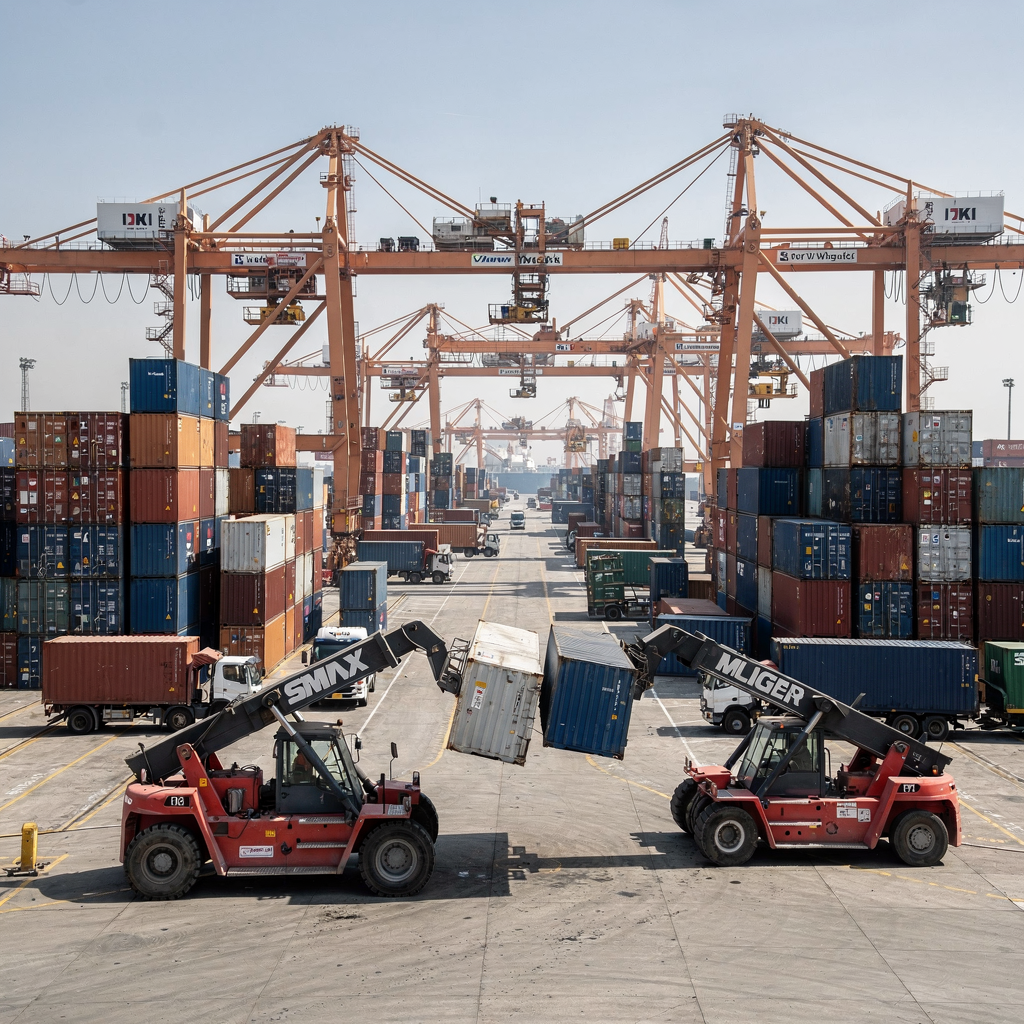
RS productivity metrics include moves per hour per unit, average travel distance, and rehandles per retrieval. Terminals set yard throughput targets by balancing quay productivity and storage yard flow. And planners track KPIs such as crane utilisation and average container dwell. Also, monitoring gate throughput helps the terminal balance shifts and labour. For terminals that want to improve, small reductions in rehandles translate into significant productivity gains. For instance, one case study reported reducing rehandles from 25% to 10% using a job prioritisation model, which raised yard productivity by about 12% (case study).
Common bottlenecks arise when RS tasks follow ad hoc or purely FIFO rules. Then, containers that block heavy-demand stacks remain in place. And quay cranes wait for releases. Also, uneven workload among yard cranes creates pockets of congestion, and drivers circle looking for work. The container relocation problem appears when planners must reshuffle many containers to reach a few high-priority boxes. Therefore, terminals must structure priorities to reduce blocked containers and to optimise operator routing.
To manage these issues, terminals adopt coordinated scheduling and performance feedback. For more detail on stowage and quay-side planning that affects RS priorities, see our guide on stowage planning fundamentals Stowage planning fundamentals. And for equipment job allocation approaches that influence yard flow, our work on container terminal equipment job allocation offers deeper methods equipment job allocation. Also, integrating TOS-agnostic plugins helps RS telemetry and tasking work alongside legacy systems TOS-agnostic plugins. Together, these steps transform disorder into organised and measurable operations.
Drowning in a full terminal with replans, exceptions and last-minute changes?
Discover what AI-driven planning can do for your terminal
Automate
Automate RS scheduling by feeding real-time telemetry and by using dynamic optimisation engines. Terminals gather AIS, RFID, and yard sensor feeds to inform immediate choices. And when systems ingest live truck, vessel, and crane states, RS task lists shift on the fly. For example, the Port of Antwerp found that integrating live data with RS operations reduced rehandles by up to 15% (Port of Antwerp study). So, automating priorities yields measurable benefits.
AI and optimisation engines support dynamic job sequencing. They rank moves not just by FIFO, but by accessibility scores and by downstream impacts. Also, reinforcement learning agents can explore thousands of sequencing strategies in a simulated terminal, and they can learn to protect quay productivity while minimising yard reshuffles. Loadmaster.ai trains three closed-loop agents—StowAI, StackAI, and JobAI—which together automate planning, placement, and execution. And this split of responsibilities allows each agent to specialise and to coordinate in live operations. Also, because the agents train in a digital twin, terminals gain a cold-start solution that does not depend on historical data.
Real-time automation can also integrate predictive maintenance feeds and operator availability. Then, the system avoids assigning long routes to machines that soon need service. And it keeps workload balanced across RTGs, yard cranes, and reach stackers. Furthermore, automation helps implement stacking strategies that reduce the container stacking problem and make retrieval faster. Finally, when systems automate job prioritisation they lower rehandles, cut fuel use, and smooth operations.
Container handling
When comparing heuristic rules to optimisation models, the differences show in rehandles and travel time. Heuristics such as FIFO or simple accessibility scores work well for small yards. And they remain popular because they are easy to explain. But they struggle under shifting vessel mixes and when yard states change often. Optimisation models, by contrast, consider multiple objectives. They aim to minimize travel and to order moves that protect future plans. For example, terminals that adopted an RS scheduling model saw an 18% fall in average handling time (study).
Mathematical approaches solve for sequences that minimize the total travel and reshuffles. They use integer programming, heuristics, or metaheuristics. And more recent work applies deep reinforcement learning to learn policies that generalise across situations. Also, optimisation can directly target the container relocation problem, striving to minimize the number of relocations while keeping productivity high. The objective often includes constraints on crane schedules, gate windows, and machine availability. Then, the solver outputs a ranked job list for reach stackers that reduces blocked containers and that keeps quay cranes fed.
Operationally, implementing optimisation means changing dispatcher workflows and training operators. The system should provide clear, executable orders and explain the rationale for each sequence. Loadmaster.ai focuses on explainable KPIs so planners keep oversight. Also, by simulating millions of decisions, the AI agents provide robust policies that work across peak and off-peak conditions. This reduces firefighting, and it helps teams shift from reactive responses to proactive planning. And because optimisation lowers unnecessary moves, terminals cut emissions and energy costs. Indeed, research links fewer reshuffles to roughly 10% lower fuel consumption and to lower CO2 from equipment use (efficiency study). Therefore, investment in optimisation pays operational and environmental dividends.
Drowning in a full terminal with replans, exceptions and last-minute changes?
Discover what AI-driven planning can do for your terminal
Automated container terminal
An automated container terminal combines remote or autonomous equipment, supervisory control, and a terminal operating system (TOS). Automated reach stackers and automated guided vehicles operate inside a controlled yard block. And supervisory software reconciles quay schedules with yard tasks. Integration with TOS and with maintenance modules keeps equipment working and prevents sudden blockages. Also, twin automated stacking cranes and automated reach stackers can run coordinated moves that minimise reshuffles.
Automation requires planning layers for scheduling in automated container terminals and for path planning in automated container yards. These layers aim to minimize the makespan of pickup and delivery tasks and to reduce waiting times for trucks. Also, integrated scheduling in automated container solutions helps balance multi-objective goals such as protecting quay throughput while reducing container relocation. For terminals testing full automation, pilots showed gains in consistency and in reduced human error. And when the control logic ties into maintenance modules, terminals gain predictive servicing that avoids unexpected downtime.
Environmental gains are tangible. Studies link fewer moves to approximately 10% lower fuel use and emissions from yard equipment (study). And automated container terminal based systems can enforce energy-saving routing and idle-time reduction. For those exploring a full automation path, our guide on the future of autonomous container terminals explains practical steps and pitfalls future of autonomous container terminals. Also, synchronising fleet management with TOS execution ensures that RS and AGV fleets follow a cohesive plan and avoid duplicate work fleet synchronisation.
Yard management
Yard management coordinates placements, reshuffles, and RS task lists to reduce congestion. Good yard management balances workload across cranes and across yard blocks. And it sequences moves to protect high-demand stacks. Coordinated RS task lists prevent repeated visits to the same container block, and they reduce empty travel. Also, balancing workloads across equipment reduces local congestion and improves operator safety.
Quantified benefits from smarter yard management are strong. One reported result showed a 12% increase in yard productivity and faster vessel turnarounds after adopting a prioritisation model (case study). And when terminals aim to minimize the total number of relocations, they free quay cranes sooner and speed up truck cycles. Continuous monitoring and feedback loops make the gains durable. Loadmaster.ai recommends continuous policy testing in a digital twin and incremental deployment so operations can verify each KPI improvement. Also, consider monitoring tools that highlight when operator choices diverge from recommended sequences.
Best practices include clear execution rules, live dashboards, and periodic re-evaluation of stacking strategies. Keep storage yard layouts flexible so the system can adapt to vessel mix changes. And schedule regular training for operators to interpret AI-driven priorities and to trust automated guidance. Finally, deploy guardrails that stop risky choices and add explainable logs for terminal management. These steps together improve container allocation, reduce the container stacking problem, and strengthen overall terminal resilience. For further reading on idle-time reduction and how to synchronise software with equipment telemetry, consult our resources on optimising idle times and TOS-agnostic integration optimising idle times and TOS-agnostic integration.
FAQ
What is a reach stacker and what role does it play in container yards?
A reach stacker is a mobile lifting machine used to move and stack containers within a container yard. It handles container stacking, retrieves boxes from stacks, and supports quay crane operations.
Why do rehandles matter in container terminals?
Rehandles add extra moves that consume time, fuel, and labour. They can constitute 20–30% of moves in poorly optimised yards, which reduces productivity and increases costs (source).
How can terminals minimize rehandles with job prioritisation?
Terminals can prioritise RS jobs by accessibility, by destination, and by downstream impact on quay cranes. Optimisation models and AI agents can sequence moves to protect high-demand stacks and to minimize reshuffles.
What technologies support real-time RS tasking?
Real-time feeds such as AIS, RFID, and yard sensors support dynamic scheduling. AI and optimisation engines then use that data to update priorities live and to reduce unnecessary relocations.
Are there measurable benefits from automating RS priorities?
Yes. Case studies report rehandle reductions up to 15% and handling-time reductions up to 18% after adopting dynamic scheduling and optimisation (study). These gains speed up vessel turnaround and lower emissions.
How do optimisation models differ from simple heuristics?
Heuristics use fixed rules like FIFO or simple accessibility scoring. Optimisation models consider multiple constraints and objectives, and they search for sequences that minimize travel and reshuffles across many moves.
Can automated container terminal systems work with existing TOS platforms?
Yes. Modern solutions often integrate with TOS via APIs or EDI and remain TOS-agnostic. This allows terminals to keep legacy systems while adding smarter tasking layers.
How does yard management reduce congestion and improve productivity?
Yard management coordinates placements and RS task lists to balance workload and avoid repeated visits to the same block. This reduces idle time, lowers travel distances, and increases moves per hour.
What role does reinforcement learning play in RS scheduling?
Reinforcement learning trains agents in a digital twin to explore policies that outperform historical averages. RL can find trade-offs that protect quay productivity while minimizing reshuffles, and it adapts to new conditions without long historical datasets.
Where can I learn more about implementing these approaches in my terminal?
Start with practical guides on stowage planning and equipment job allocation, and then pilot AI policies in a digital twin. See our resources on stowage planning fundamentals and container terminal equipment job allocation to begin stowage planning and equipment job allocation.
our products
 stowAI
 stackAI
 jobAI
jobAI
Innovates vessel planning. Faster rotation time of ships, increased flexibility towards shipping lines and customers.
Build the stack in the most efficient way. Increase moves per hour by reducing shifters and increase crane efficiency.
Get the most out of your equipment. Increase moves per hour by minimising waste and delays.
stowAI
Innovates vessel planning. Faster rotation time of ships, increased flexibility towards shipping lines and customers.
stackAI
Build the stack in the most efficient way. Increase moves per hour by reducing shifters and increase crane efficiency.
jobAI
Get the most out of your equipment. Increase moves per hour by minimising waste and delays.