
Literature Review of Port Container Terminals and Crane Automation
The literature review of port container terminals and crane automation surveys decades of work on stacking, scheduling, and control. Early studies focused on manual rules and deterministic schedules. Later work integrated big data and AI to handle uncertainty. For example, researchers showed the synergistic benefits of operational research and big data analytics in yard operations through simulation studies. Also, doctoral research has mapped how sensors, IoT, and algorithms shift decision making in modern terminals at Newcastle University. Twin automated stacking cranes and algorithmic job distribution yield meaningful improvements. The literature contrasts rule-based approaches with learning agents. Studies report efficiency gains in crane utilization and reduced idle time, with some reporting up to 30% berth capacity improvement after automation in empirical analyses. Safety and reliability also improved in trials and reports published findings. Yard operations require rich data. Sensors must report bay occupancy, container ID, and cell status. Terminal Operating Systems need real-time telemetry, and the model inputs include number of containers and number of rows per block. Resource allocation metrics track moves per hour, waiting time, and travel distance. However, gaps remain. Integration of scheduling optimization with live quay crane scheduling problem inputs is limited. Cybersecurity and data quality remain open risks. Also, models rarely capture stochastic vessel arrivals or sudden gate spikes. The paper is organized as follows: this section surveys background, then mathematical formalisms and optimisation follow. Goodchild and Daganzo and Kim and Park are often cited for foundational transport models. Gharehgozli et al introduced mixed integer approaches. An open access article distributed in several repositories provides comparative algorithms. Finally, literature still calls for research on transition to automation and on human-in-the-loop designs.
Mathematical Model for Rail Mounted Gantry Crane Job Allocation
This section presents a mathematical model that captures job allocation and yard crane scheduling. The objective is to minimize idle time and makespan. Decision variables include assignment x_{t,c} that links tasks to a specific crane and start times s_{t}. The objective is to minimize the total completion time and to minimize the makespan. Constraints enforce crane interference limits, bay compatibility, and task precedence. For rail mounted gantry units, rail geometry and crane configuration restrict simultaneous moves. The model and algorithm combine a mixed integer programming model with heuristics to achieve real-time performance. Specifically, the model may be written as a mixed integer formulation with binary assignment variables and continuous start time variables. A branch and bound routine can solve small instances. For larger blocks, a two-phase solution method first groups tasks by bay and then sequences them using greedy insertion. Operation time constraint and driving distance are incorporated. The objective is to minimize crane idle time while meeting precedence and safety buffers. To support real-time use, linearisation techniques convert nonlinear travel-time terms to piecewise linear approximations. This allows a mixed integer program to be solved quickly by modern solvers. In practice, the mathematical model must interact with the Terminal Operating System and telemetry. Live data streams update the number of containers in a block and the sequence of container arrivals. The objective of minimizing rehandles appears explicitly in the cost function. The model also includes a constraint that limits the total number of simultaneous moves per rail mounted gantry crane. For deployable systems, a model and solution that delivers near-optimal solution within seconds is essential. Our company, Loadmaster.ai, trains RL agents in a digital twin so that the model supports policy execution rather than only offline optimisation. This reduces reliance on historical data that traditional mixed integer programming model approaches require.
Drowning in a full terminal with replans, exceptions and last-minute changes?
Discover what AI-driven planning can do for your terminal
Ant Colony Optimization in Terminal Logistics
Ant colony optimization explains a bio-inspired approach to the scheduling problem. Ant Colony Optimization models solutions as paths and updates pheromone trails that bias future searches. First, a colony of agents constructs candidate sequences. Then, pheromone update rules reward high-quality solutions. Next, evaporation reduces over-exploitation and preserves exploration. Heuristic information complements pheromone values. In terminal settings, heuristics may include task priority, proximity, and predicted gate arrivals. For example, a task proximity heuristic prefers moves that reduce travel distance. Also, priority factors reduce waiting time for inbound trains or trucks. The ant colony approach adapts well to dynamic data inputs. When real-time telemetry changes, pheromone weights adapt and new solution paths emerge. Ant colony optimization competes with genetic algorithms and tabu search in benchmark trials. Comparative studies show that ACO finds good solutions quickly for medium-sized yard crane scheduling problems. However, for very large instances a hybrid is often best. Therefore, practitioners combine ACO with local search and with branch and bound seeds. The scheduling optimization model often includes objective functions that minimize the total completion time and minimize crane idle time. Ant colony optimization also supports multi-objective trade-offs, which helps terminal operators balance quay productivity and yard congestion. In experiments, ACO reduced rehandles and cut time in handling by measurable margins. In many trials, ant colony optimization produced near-optimal solution quality while keeping computation time low. For more details on synchronising gantry travel with job schedules, see our discussion on synchronizing ASC travel with job scheduling in container ports, which explains integration with equipment telemetry and TOS interfaces synchronizing ASC travel with job scheduling. The ant colony approach remains a viable option when adaptive heuristics guide construction and pheromones encode past success.
Implementation in Port Container Handling with Rail Mounted Gantry
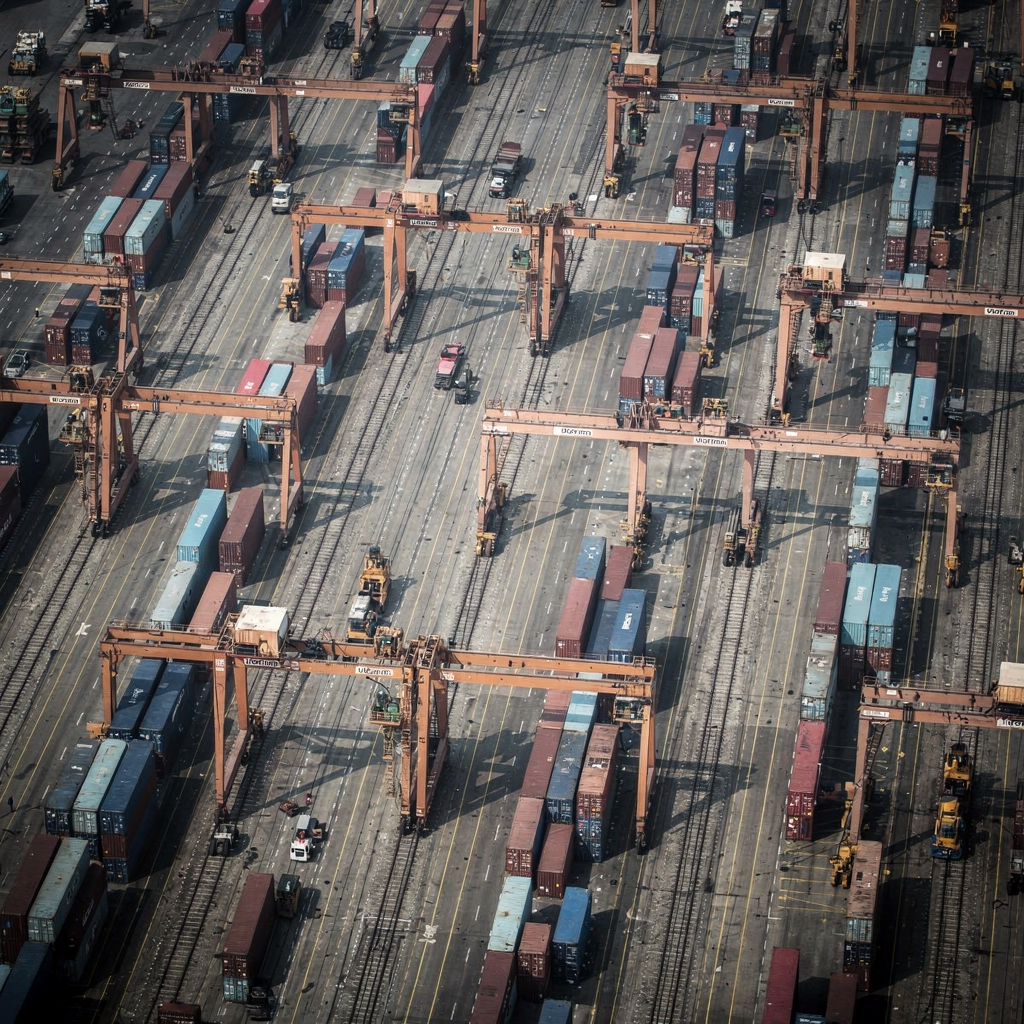
Implementing automated rail-mounted gantry systems requires layered integration. First, IoT sensors feed cell occupancy and crane telemetry to the Terminal Operating System. Next, a decision layer executes assignment policies and dispatches moves. For real-world deployment, network architecture must ensure low latency and redundancy. Systems often include MQTT or OPC-UA layers for telemetry and REST APIs for task commands. At a process level, workflow runs from vessel discharge to yard stacking and to job assignment. A vessel arrives, quay cranes unload containers, and yard teams coordinate with rail mounted gantry units for stacking. Quay crane scheduling problem outputs become inputs to yard allocation. JobAI-style agents can automate dispatcher decisions and coordinate moves across quay, yard, and gate. Loadmaster.ai follows this pattern by training agents in a digital twin and then deploying policies that interact with live TOS data. The deployment reduces unnecessary driving distance and balances workload across gantry units. Case evidence shows major operators report reliability gains after automation. For instance, APM Terminals MedPort Tangier increased berth capacity and customer reliability by installing more automated equipment company communication. Simulation and pilot trials often report throughput improvements of 15% to 25% when job allocation and yard crane scheduling are automated project studies. System integration also ties into predictive maintenance. Sensors report vibration and motor hours so that planners can schedule outages without disrupting flow. For detailed predictive workflows see our guidance on predictive maintenance to reduce deepsea container port crane downtime predictive maintenance for cranes. Finally, the implementation phase must address human factors. Terminal operators need training and clear guardrails. The transition to automation must be staged and auditable to meet regulatory and operational governance.
Drowning in a full terminal with replans, exceptions and last-minute changes?
Discover what AI-driven planning can do for your terminal
Performance Evaluation of Gantry Crane Scheduling at Container Terminal
Performance evaluation requires clear KPIs. Key performance indicators include throughput, crane utilisation, total completion time, and waiting time. For yard blocks, monitor stack density, number of rehandles, and average driving distance. Simulation studies and on-site trials commonly use discrete-event simulation. They also use digital twins to run millions of scenarios. In trials, automated allocation reduced idle time by up to 30% and raised terminal productivity across shifts. Empirical data from several terminals indicate throughput gains in the 15–25% range after automation efficiency studies. Safety enhancements follow from reduced manual intervention and from advanced control systems that enforce safe separations. In addition, predictive maintenance lowers unexpected downtime. To evaluate the performance of a model and algorithm, researchers compare the scheduling optimization model against heuristics and metaheuristics. Metrics include makespan and total completion time and the objective of minimizing rehandles. A mixed integer programming model often provides a baseline optimal solution for small instances. Then, ACO and other metaheuristics are applied to scale up. Results usually show that heuristics reach near-optimal solution quality while preserving computational speed. Also, the deployment must track energy and carbon metrics. Reducing travel and idle time supports reducing carbon emissions. When evaluating the effectiveness of the deployment, terminals should measure stability over multiple shifts. Loadmaster.ai emphasizes consistent results independent of individual planners. Our closed-loop agents improve consistency and reduce the need for firefighting. To learn about reducing idle time specifically, see our analysis on reducing deepsea container port equipment idle time reducing equipment idle time. Lastly, field trials should report both statistical improvements and operational anecdotes to build confidence with terminal operators.
Future Directions in Transportation Research Part for Port Operations
Future research will link AI, big data analytics, and digital twin technologies. Transportation Research Part articles suggest applying digital twins to train policies and to stress-test schedules under disruptions. AI will expand beyond prediction into policy learning. Reinforcement Learning agents will adapt to new vessel mixes, and to gate spikes, and they will trade off quay productivity versus yard congestion. Also, autonomous guided vehicles and automated guided solutions will complement gantry operations. Predictive maintenance and energy optimisation will reduce operational costs. The trend toward integrated control of quay cranes, yard crane scheduling, and gate dispatch is accelerating. In research, hybrid methods that combine ant colony optimization with RL policies may yield robust schedulers. Moreover, privacy-preserving data sharing and cybersecurity are essential as terminals become more connected. The transportation research part of the community should explore digital twin standards and shared benchmarks. Specific directions include models for container storage allocation and for sequence of container moves that minimize reshuffles. Researchers should test automated container terminals under varied traffic patterns and time of ships scenarios. Also, more work on human-agent cooperation will help with the transition to automation. Recommended areas for further research include advanced control systems that adapt to new constraints, improving model and solution explainability, and applying mixed integer and learning-based hybrids to complex yard crane scheduling problem instances. Finally, continued field pilots, open datasets, and cross-terminal studies will accelerate safe and measurable progress in container handling and container transportation.
FAQ
What is rail mounted gantry crane job allocation automation?
Rail mounted gantry crane job allocation automation assigns stacking and retrieval moves automatically to gantry units using algorithms. The system uses sensors, TOS data, and AI to schedule and dispatch moves in real time.
How does automation improve throughput at a container terminal?
Automation reduces idle time and balances workloads, which increases moves per hour and overall throughput. Studies and pilots report throughput gains often in the 15–25% range when job allocation and yard crane scheduling are automated (project studies).
Which algorithms are used for the scheduling problem?
Practitioners use mixed integer programming, branch and bound, ant colony optimization, and RL-based policies. Small instances may use exact mixed integer programming model solvers, while larger cases use metaheuristics or learned policies for speed.
What is ant colony optimization and why use it?
Ant colony optimization is a bio-inspired metaheuristic that builds solutions incrementally and updates pheromone trails to bias future searches. It works well when heuristic information like proximity and priority aids construction, and it scales to medium-sized yard crane scheduling problems.
How does Loadmaster.ai fit into this ecosystem?
Loadmaster.ai trains RL agents in a digital twin to create closed-loop policies for stowage, stacking, and job dispatch. This approach reduces reliance on historical data and improves consistency across shifts. The agents integrate with TOS and telemetry to execute in live operations.
What data does an automated system need to function?
The system needs cell occupancy, container IDs, bay layout, crane telemetry, and gate and quay schedules. It also benefits from predictive inputs like maintenance flags and arrival time estimates to reduce waiting time and to minimize rehandles.
Can automation reduce carbon emissions?
Yes. By shortening driving distances and cutting idle time, automation reduces fuel or energy use and thereby reduces carbon emissions. Performance evaluations often include energy metrics alongside throughput and utilisation.
Are automated rail-mounted gantry systems safe?
Automated systems can improve safety by limiting human exposure near moving equipment and by enforcing separation rules through advanced control systems. Nevertheless, robust cybersecurity and fail-safes remain necessary to ensure safe operation.
What is the role of predictive maintenance in these deployments?
Predictive maintenance uses sensor data to forecast failures and to schedule work proactively, reducing unexpected downtime. Terminals that apply predictive maintenance report higher reliability and better berth capacity utilization.
How should terminals evaluate the performance of new scheduling solutions?
Terminals should measure throughput, crane utilisation, makespan reduction, and rehandle count over many shifts. Simulations and digital twins should run stress tests for gate spikes and vessel delays, and field pilots should validate simulation results in live operations.
our products
 stowAI
 stackAI
 jobAI
jobAI
Innovates vessel planning. Faster rotation time of ships, increased flexibility towards shipping lines and customers.
Build the stack in the most efficient way. Increase moves per hour by reducing shifters and increase crane efficiency.
Get the most out of your equipment. Increase moves per hour by minimising waste and delays.
stowAI
Innovates vessel planning. Faster rotation time of ships, increased flexibility towards shipping lines and customers.
stackAI
Build the stack in the most efficient way. Increase moves per hour by reducing shifters and increase crane efficiency.
jobAI
Get the most out of your equipment. Increase moves per hour by minimising waste and delays.