
berth and quay cranes in container terminal operations
Berth and quay cranes together form the backbone of seaside operations in container terminals. First, the berth provides the physical space where a vessel moors. Next, quay cranes lift, move, and exchange containers between ship and shore. Together, they determine how fast a vessel clears the quay and how quickly containers flow into the yard and onto trucks. Also, these two resources link directly to key performance indicators that managers watch every day.
Key performance indicators include vessel turnaround time, berth occupancy, and crane productivity. Vessel turnaround time measures hours from arrival to departure. Berth occupancy measures how long berths are in use relative to available quay length. Crane productivity tracks moves per hour per crane. Together, these KPIs paint a clear picture of terminal throughput and cost. Therefore, optimizing berth allocations and quay cranes scheduling directly translates to faster ships and lower costs.
The interdependence between berth availability and quay crane deployment is strong. When a berth is occupied with a vessel that has few quay cranes assigned, the vessel’s turnaround time often rises. Conversely, a long stretch of quay with many cranes can reduce vessel waiting time but may create yard congestion later. Thus, planners must balance berth allocations with the number and placement of quay cranes to avoid bottlenecks. Planners also consider vessel length, cargo priority, and projected arrival times when they decide where to place a vessel along the quay.
Dynamic approaches to berth and quay crane coordination help ports respond to uncertainty. For example, dynamic berth allocations that update in near-real-time allow a terminal to react to vessel arrival delays and equipment outages. At the same time, adaptive quay cranes sequences reassign cranes to high-priority calls so that moves/hour remain high. These strategies reduce idle time for both berths and cranes, and they cut vessel waiting time.
Industry research confirms the value of robust coordination. One study defines a robust schedule as “a schedule with as little conflicts as possible which remains valid under changing arrival times” [source]. That definition underlines why planners must design berth allocations and crane plans that tolerate disruptions. For readers who want practical guidance, Loadmaster.ai’s work integrates RL agents to balance quay productivity against yard congestion, helping to make berth decisions that keep the entire chain flowing smoothly. If you want to explore related techniques for minimizing truck travel and optimizing yard moves, see the discussion on minimizing internal truck travel here.
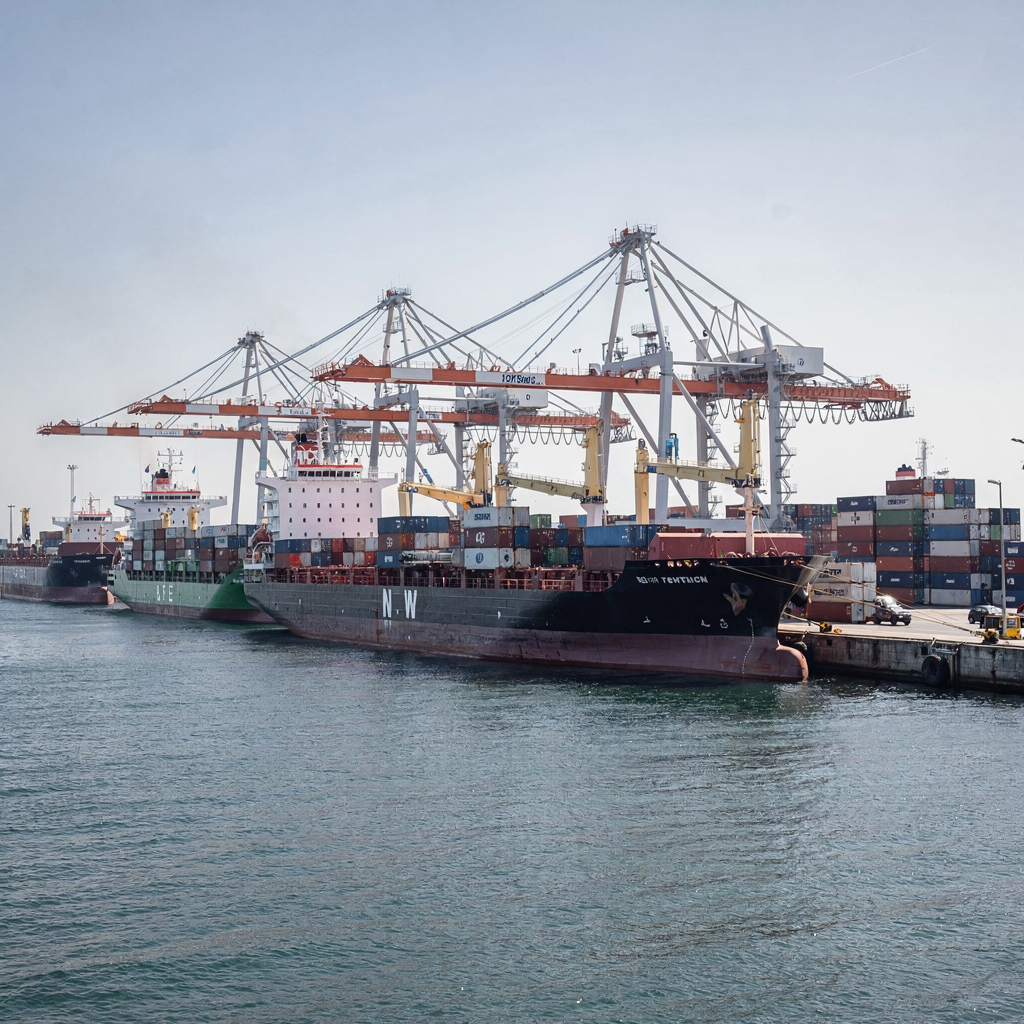
Dynamic container terminal berth allocation strategies
Static berth assignment locks vessels to predefined slots and resists change. Dynamic berth allocation treats the quay as a scheduling canvas that updates as new information arrives. Dynamic berth allocation uses real-time data such as estimated time of arrival, actual approach speed, and tug availability to reassign positions and times. As a result, terminals can reduce waiting lists, shorten queues, and cut emissions by avoiding long idling periods for ships.
Decision criteria matter. Planners consider vessel arrival delays, available quay lengths, and priority cargo when they make allocation choices. For example, containerized high-priority cargo or perishable reefers may trigger earlier assignment to a berth near cold-chain facilities. Also, available quay length limits where a vessel can fit; planners must avoid overlaps and respect safety spacing. Therefore, algorithms evaluate both physical constraints and operational goals before committing to a plan.
Machine learning often supports prediction of arrival times and improves berth allocation. Recent studies show that using ML to forecast vessel arrivals can reduce vessel turnaround time by up to 15% [source]. ML models ingest AIS traces, weather patterns, and historical port call behavior. Then, ML produces arrival time estimates that feed dynamic allocation solvers, so planners can create schedules that are more resilient to disruption.
Practically, terminals choose between discrete berth allocation and continuous berth allocation frameworks. Discrete berth allocation divides the quay into fixed slots and assigns vessels to one of them. Continuous berth allocation allows flexible positioning along the quay, which can increase utilization but adds complexity to ship manoeuvring and crane reach planning. Both approaches require algorithms that handle time overlaps, tug scheduling, and quay crane reach constraints.
For terminals seeking to integrate quay crane sequencing with berth placements, advanced allocation and quay crane assignment methods exist. A bi-layer model, for example, coordinates berth placements at the higher level and quay crane assignment at the lower level so that cranes are assigned after berth positions firm up [source]. Loadmaster.ai’s RL-based agents replicate such coordination in a digital twin. The agents train on your terminal layout so that allocation choices preserve yard balance and crane productivity. For more on crane downtime and predictive fixes, consult predictive maintenance guidance here.
Drowning in a full terminal with replans, exceptions and last-minute changes?
Discover what AI-driven planning can do for your terminal
Models for quay crane scheduling problem
Quay crane scheduling is often formulated with mixed-integer programming or heuristic search. Mixed-integer programming offers precise optimization when terminals can afford computation time. Heuristics deliver near-optimal plans quickly and scale to large terminals. Planners pick the model based on the scheduling problem they face and the acceptable solution time. In practice, many use hybrid approaches that embed heuristics inside exact frameworks to get the best of both worlds.
Critical constraints shape any quay crane scheduling approach. Crane interference is a major limit: two adjacent cranes cannot cross paths, so the planner enforces safety margins and sequencing rules. Energy consumption also matters; some scheduling methods minimize crane idle energy or smooth high power draws. Additionally, planners must account for the number of quay cranes available and their reach, which affects where a vessel can be assigned and how moves are sequenced. That interplay tightens the problem space and drives creative modeling.
Quay crane scheduling problem variants include single-vessel sequencing, multi-vessel assignment, and joint scheduling that couples cranes to berth choices. For example, the quay crane assignment problem assigns a specific number of cranes to a berth for a given time window. Then, quay crane scheduling sequences individual moves to minimize total handling time and avoid interference. Practical QC scheduling often also factors in container handling time per move and yard availability so that unloading does not create downstream congestion.
Case studies demonstrate measurable benefits. Simulation and field trials report reduced handling time and increased throughput when advanced scheduling solutions are applied. One simulation study found berth utilization improvements of 10–20% when berth allocation and crane sequences were coordinated [source]. Likewise, targeted crane sequencing reduces rehandles and shortens vessel dwell time. For terminals that want an automated approach, tools that integrate crane scheduling with job dispatch and yard moves—such as Loadmaster.ai’s JobAI and StowAI—help cut wait times while keeping cranes busy and balanced across shifts. You can learn more about KPI-driven optimization approaches in the container terminal KPIs guide here.
Techniques for berth allocations under uncertainty
Uncertainty drives the need for robust methods in berth allocations. Two prominent techniques are stochastic programming and robust optimisation. Stochastic programming models randomness explicitly by sampling possible future arrival scenarios and optimizing expected performance across them. Robust optimisation, on the other hand, seeks solutions that perform well for the worst plausible scenarios. Both reduce the sensitivity of berth allocations to delays and equipment failures.
Research quantifies the benefits. Machine learning enhanced berth planning and robust schedules can cut vessel waiting times by up to 15% through better prediction and dynamic updates [source]. In further studies, simulation-based disruption recovery that adds proactive slack has improved berth utilization rates by 10–20% [source]. Those gains matter because lower waiting times reduce fuel burn in anchorage and thus lower CO2 emissions; one report estimates berth optimisation can cut port-related CO2 by up to 8% [source].
Simulation-based disruption recovery frequently pairs with proactive slack incorporation. In practical terms, planners reserve a modest time buffer or leave a short section of quay flexible. That buffer allows the plan to absorb a late vessel without cascading delays. Also, simulation tests many “what-if” incidents—such as crane breakdowns or sudden weather changes—so planners can see how berth allocations behave under stress. The result is a plan that is easier to adapt during live operations and that lowers firefighting effort on the operations floor.
Finally, a hybrid approach often yields the best results: use ML to predict arrivals, use stochastic programming to propose candidate allocations, and run fast simulation to validate them before deployment. Terminals that adopt such a pipeline reduce rehandles and maintain higher service levels. For those integrating berth allocations with crane maintenance planning and equipment reliability, predictive maintenance insights are helpful; see research on reducing crane downtime here.
Drowning in a full terminal with replans, exceptions and last-minute changes?
Discover what AI-driven planning can do for your terminal
Integration of quay crane scheduling and allocation
Integrating berth allocations with quay crane scheduling creates synergy. Bi-layer models coordinate a top-level berth allocation and a lower-level crane schedule so that both resources optimize the same objectives. In other words, the model chooses where and when to berth a vessel while simultaneously deciding how many cranes and which sequences to use. This joint approach reduces conflicts and often improves terminal throughput.
Reported efficiency gains from joint models are strong. Simulation studies and field pilots show 10–20% improvement in berth utilisation and crane productivity when berth allocation and quay cranes plans are coordinated [source]. The gains come from avoiding situations where a berth is occupied but under-craned, or where many cranes idle because a vessel was placed too far from a staging area. Joint scheduling closes those gaps by ensuring the plan assigns adequate crane resources when a berth is used.
Computational considerations are important. Integrated models increase problem size and therefore solution time. To keep runtimes practical, researchers apply decomposition, heuristics, and warm-start methods. Decomposition splits the allocation problem into manageable pieces, and heuristics find high-quality feasible plans quickly. Some teams also use RL and simulation-based policy training to produce near-optimal policies in real time. For example, deep reinforcement learning approaches can learn allocation and sequencing policies from simulated experience and then execute them with low latency on the operations network [source].
Practitioners pick approaches that match their response-time needs. If a terminal needs decisions in seconds, heuristics or trained RL policies are attractive. If a terminal can afford minutes for planning, mixed-integer programs with decomposition may deliver marginally better performance. Loadmaster.ai trains RL agents in a sandbox digital twin so that integrated berth allocation and quay crane assignment policies arrive cold-start ready and then refine online with live feedback. For further reading on berth and crane planning best practices, check the practical guide here.
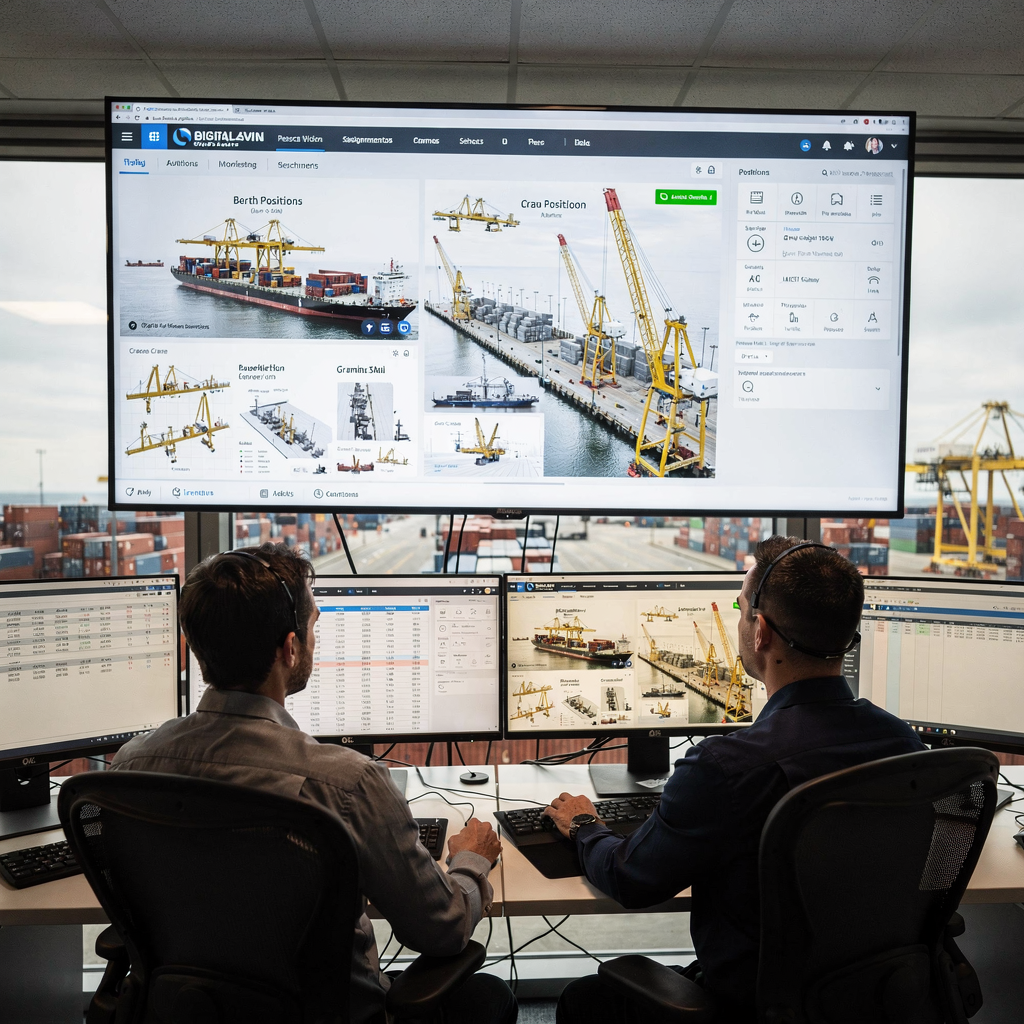
Addressing the scheduling problem in deepsea container terminals
Deepsea container terminals face a multi-objective scheduling problem that balances cost, time, and environmental impact. Planners aim to minimise vessel delays and operating costs while also cutting emissions and energy use. This multi-objective nature requires models that can trade one goal against another, and planners often assign weights that reflect commercial and sustainability priorities. Also, regulatory requirements such as emissions caps influence those priorities.
Recent AI and machine learning solutions address these needs. Supervised ML helps with prediction, and reinforcement learning produces policies that can reason about long-term trade-offs. For example, a deep reinforcement learning approach can learn to trade a small increase in crane travel for a larger reduction in downstream yard reshuffles. These agents simulate millions of decisions so they can generalize to unseen vessel mixes and equipment failures. Unlike historical ML, RL searches policy space to find new strategies rather than imitating past practice.
Future trends point to richer real-time data integration and resilience features. Terminals will increasingly use digital twins and live telemetry to feed allocation and quay crane scheduling engines. Digital twins enable safe stress-testing of plans and let RL agents train without risking operations. Also, resilient decision-support systems will combine robust optimisation with adaptive scheduling so that plans remain valid when reality deviates from forecasts.
Loadmaster.ai’s closed-loop approach illustrates these ideas in production. StowAI, StackAI, and JobAI coordinate quay crane planning, yard placement, and dispatching to keep KPIs stable across shifts. The method requires no historical data because the agents generate experience in simulation before live deployment. That capability addresses common pain points: firefighting instead of planning, inconsistent performance, and loss of tribal knowledge when senior planners retire. For terminals interested in automating equipment dispatch and reducing empty driving, review the equipment dispatching guide here.
FAQ
What is the difference between static and dynamic berth allocations?
Static berth allocations assign vessels to fixed quay slots based on a pre-set plan that rarely changes. Dynamic berth allocations update positions and times in near-real-time using fresh information like arrival delays and equipment status.
How do quay cranes influence vessel turnaround time?
Quay cranes control the flow of containers between ship and shore, so their productivity directly affects how long a vessel stays at the quay. Effective quay crane scheduling reduces idle crane time and increases moves per hour, which shortens vessel dwell time.
Can machine learning improve berth allocation accuracy?
Yes. Machine learning models predict vessel arrival times and detect patterns that reduce uncertainty. Studies report up to a 15% reduction in turnaround time when ML supports berth allocation [source].
What is a bi-layer model for berth allocation and quay crane planning?
A bi-layer model separates the problem into a top layer that selects berth positions and a lower layer that assigns and sequences quay cranes. This structure balances global berth utilisation with local crane efficiency, reducing conflicts and improving throughput [source].
How do terminals manage uncertainty like late arrivals or crane failures?
Terminals use stochastic programming, robust optimisation, and simulation-based recovery to build plans that absorb disruptions. Adding proactive slack and testing scenarios in simulation improves resilience and reduces firefighting on the operations floor.
What role do digital twins play in scheduling?
Digital twins let operators simulate millions of scenarios before applying policies live. They support training of RL agents and validate how berth allocations and quay cranes schedules perform under stress, all without disrupting real operations.
Are integrated berth allocation and quay crane schedules computationally expensive?
Yes, integrated models increase problem size and may require more compute time. However, decomposition, heuristics, and RL-based policies provide practical ways to get near-optimal solutions with acceptable runtimes.
How much can berth optimisation reduce emissions?
Optimising berth allocation can lower CO2 emissions from port operations. Studies estimate reductions of around 8% when queuing and allocation improve [source].
What is the value of reinforcement learning in container terminal scheduling?
Reinforcement learning finds policies that balance multiple KPIs and adapt to changing conditions. It does not require historical data because agents learn by simulating interactions in a digital twin, producing actionable policies even for terminals with scarce history.
Where can I learn best practices for berth and crane planning?
Operational guides and vendor papers explain best practices. For a practical starting point, see a container terminal berth and crane planning resource here, and explore predictive maintenance advice for cranes here.
our products
 stowAI
 stackAI
 jobAI
jobAI
Innovates vessel planning. Faster rotation time of ships, increased flexibility towards shipping lines and customers.
Build the stack in the most efficient way. Increase moves per hour by reducing shifters and increase crane efficiency.
Get the most out of your equipment. Increase moves per hour by minimising waste and delays.
stowAI
Innovates vessel planning. Faster rotation time of ships, increased flexibility towards shipping lines and customers.
stackAI
Build the stack in the most efficient way. Increase moves per hour by reducing shifters and increase crane efficiency.
jobAI
Get the most out of your equipment. Increase moves per hour by minimising waste and delays.